
Canon EOS R6 vs R6 Mark II: The Good, Bad & Better for Weddings
If you shoot weddings on Canon, the Canon R6 vs R6 Mark II question has probably crossed your mind at a rental counter: is the newer body really worth the extra money? The Canon EOS R6 and the Canon EOS R6 Mark II are both full-frame, RF-mount mirrorless cameras built for what wedding photography demands: dim venues, moving people, long days and zero retakes.
So the Canon R6 vs R6 Mark II question is not "which one is good?" Both are. It is "which differences actually show up between the haldi and the last song at the reception?" In short, that comes down to four things: autofocus tracking, battery life, video recording limits and resolution.
This Canon R6 vs R6 Mark II comparison first walks through each one in real wedding situations, then helps you decide which body to shoot, buy or rent for your next booking.
Canon R6 vs R6 Mark II: the quick answer for wedding photographers
In the Canon R6 vs R6 Mark II choice, the Canon EOS R6 Mark II is the better camera for most wedding photographers. It adds a 24.2MP sensor (vs 20.1MP), smarter subject-detection autofocus, roughly 50% more battery life on the rear screen by Canon's figures, and it drops the 30-minute video limit that capped the original R6. However, the original Canon EOS R6 is still a capable wedding camera, especially for stills-first photographers, as a second body, or when budget matters more than video.
- Better all-rounder: R6 Mark II — stickier tracking, longer battery, no 30-minute video cap.
- Low light: basically a tie. Same ISO range, same -6.5 EV focus limit, same 8-stop IBIS.
- Still worth it: the R6 as a stills body, a second body or a backup.
- Canon R6 vs R6 Mark II rental gap: ₹500/day. R6 at ₹2,000, R6 Mark II at ₹2,500.
- Two-body wedding kit: one of each comes to ₹4,500/day.
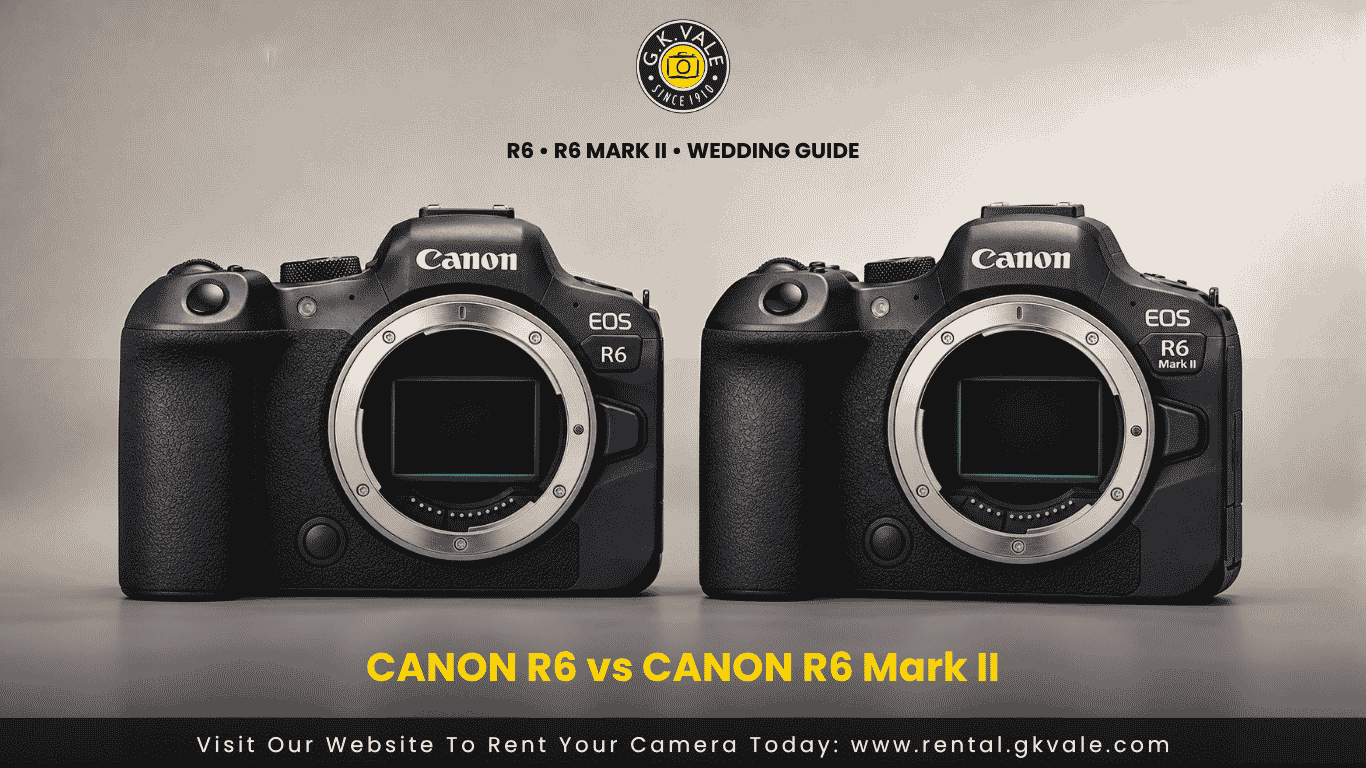
Canon R6 vs R6 Mark II at a glance
This Canon R6 vs R6 Mark II table covers only the specs that change how a wedding day goes. Figures are from Canon and B&H Photo's published comparison.
Canon R6 vs R6 Mark II: the headline differences
Canon EOS R6
- Resolution
- 20.1MP
- Electronic burst
- 20 fps
- Battery (LCD)
- ~510 shots
- 4K clip limit
- 29:59
- Rent at G.K. Vale
- ₹2,000/day
Canon EOS R6 Mark II
- Resolution
- 24.2MP
- Electronic burst
- 40 fps
- Battery (LCD)
- ~50% more
- 4K clip limit
- None
- Rent at G.K. Vale
- ₹2,500/day
Photo and autofocus specs
| Feature | Canon EOS R6 | Canon EOS R6 Mark II | Why it matters for weddings |
|---|---|---|---|
| Sensor | 20.1MP full-frame CMOS | 24.2MP full-frame CMOS | More room to crop a candid shot from the back of the mandap; slightly larger files to store |
| Autofocus | Dual Pixel CMOS AF II; eye, face and head detection for people; animal detection | Dual Pixel CMOS AF II with an updated deep-learning tracking algorithm; adds Auto subject detection and vehicle detection | Tracking that stays on the couple when relatives cross the frame during the baraat or varmala |
| AF low-light limit | Down to -6.5 EV | Down to -6.5 EV | Both can lock focus in very dim halls; no spec advantage either way |
| ISO range | 100–102,400 (expandable to 204,800) | 100–102,400 (expandable to 204,800) | Same headroom for candle-lit pheras and dark receptions |
| Burst speed | 12 fps mechanical / 20 fps electronic | 12 fps mechanical / 40 fps electronic, plus RAW burst with 0.5 s pre-shooting | Pre-shooting can catch the petal throw or the ring moment you reacted to a beat late |
| Image stabilisation | 5-axis IBIS, up to 8 stops (with compatible lenses) | 5-axis IBIS, up to 8 stops (with compatible lenses) | Sharper handheld shots at slow shutter speeds; parity |
Battery, video and handling specs
| Feature | Canon EOS R6 | Canon EOS R6 Mark II | Why it matters for weddings |
|---|---|---|---|
| Battery (LP-E6NH) | Rated approx. 510 shots (LCD) | Canon cites approx. 50% more shots in stills using the LCD | Fewer battery swaps over a 12-hour day, though EVF use narrows the gap |
| 4K video | 4K 60p (oversampled from 5.1K, slight crop), 10-bit 4:2:2, Canon Log, 29:59 clip limit | 4K 60p oversampled from 6K using full sensor width, 10-bit 4:2:2, Canon Log 3, no 30-minute limit; 6K RAW out via HDMI | Uninterrupted ceremony and speech coverage for hybrid shooters |
| Heat limits (Canon, at 23°C) | Up to 29:59 at 4K 60p; about 40 min at 4K 30p | 40+ min at 4K 60p; up to 6 hours at 4K 30p | Matters most at outdoor day weddings in Indian summer heat |
| Card slots | Dual SD UHS-II | Dual SD UHS-II | Simultaneous backup recording on both; non-negotiable for client work |
| Handling | Power switch on the left shoulder | Power switch moved beside the shutter; dedicated photo/video switch | Faster one-handed power-up between rituals |
| Wireless | Wi-Fi and Bluetooth | Faster Wi-Fi 5 (802.11ac) and Bluetooth 5.0 | Quicker phone transfers for same-day social teasers |
| Batteries, grip, lenses | LP-E6NH, BG-R10 grip, RF mount | LP-E6NH, BG-R10 grip, RF mount | Your existing batteries, grip and RF lenses work on both |
Bold = the Mark II's advantage. Rows without bold are identical on both bodies.
Is the Canon R6 Mark II better for wedding photography?
Yes, for most wedding work. The Canon EOS R6 Mark II improves on the original R6 in the areas that cause stress at weddings: autofocus tracking, battery endurance and video recording time.
The headline in any Canon R6 vs R6 Mark II comparison is that Canon lists more than 70 upgrades on the newer body. Most of them, though, are refinements, not a reinvention. The sensor size, viewfinder, rear screen and card slots are essentially the same. Instead, what changes is how reliably the camera keeps up when a wedding gets chaotic.
That matters because a wedding photographer cannot ask the bride to walk in again. A camera that holds focus on a moving couple, survives a long day on fewer batteries and records an entire ceremony without stopping removes three common failure points.
Where the R6 Mark II does not help: framing, timing, light reading and people skills. In other words, a good photographer with an R6 will outshoot an average one with a Mark II every time.
Is the R6 Mark II autofocus better than the R6?
Yes. Both use Dual Pixel CMOS AF II, but the R6 Mark II runs an updated deep-learning algorithm that Canon says tracks more accurately and sticks to subjects better. It also adds an Auto subject-detection mode.
Autofocus is where the Canon R6 vs R6 Mark II difference shows up most at a wedding. On paper the two cameras look similar: same AF system name, same -6.5 EV low-light limit. However, the real difference is in tracking behaviour, and weddings test tracking hard.
For example, think about the baraat. The groom is moving, the band is moving, and a dozen dancing cousins keep cutting across your frame. The original R6 has eye, face and head detection and handles this well most of the time. The R6 Mark II's updated tracking, by contrast, is designed to hold the chosen subject more stubbornly when something passes in front.
Wedding moments where tracking matters most
Similarly, the baraat isn't the only test. Tracking also earns its keep during:
- Varmala and entry shots, where the couple turns quickly and faces may be partly hidden by flowers or veils. Canon says the Mark II falls back from eye to face to head to body when eyes are hidden.
- First dance and sangeet performances, where subjects spin, light changes constantly and focus has to follow a face across the frame.
- Candid photography, where you are shooting through gaps in the crowd with foreground clutter everywhere.
What about autofocus for wedding video?
For video, the Mark II adds a "Detect only" AF option. Once you select a subject, the camera tracks only that subject and won't jump to the background if they leave the frame. As a result, when you film couple portraits or the bride's walk-in, there are fewer focus jumps to fix in the edit.
Where AF barely matters: posed family group photographs. After all, both cameras will nail a static group at f/5.6.
Do 40 fps and pre-shooting matter at a wedding?
Occasionally. Most wedding moments don't need 40 fps, but the R6 Mark II's RAW burst pre-shooting can rescue split-second moments like the petal shower or the confetti exit.
Burst speed is the flashiest number on the Canon R6 vs R6 Mark II spec sheet. The R6 Mark II doubles the R6's electronic-shutter burst from 20 fps to 40 fps. In addition, RAW burst mode can start buffering frames when you half-press the shutter, then save up to half a second of frames from before you fully pressed it.
At a wedding, that helps when:
- Petals or rice are thrown during the pheras or exit
- The kanyadaan or ring moment happens faster than you expected
- A child does something unrepeatable during the family photos
One caution applies to both cameras. For instance, electronic shutter at high frame rates can show banding under some LED and fluorescent venue lighting and can distort fast motion. That is why many wedding photographers keep the mechanical shutter (12 fps on both) for indoor receptions and switch to electronic only when silence or speed matters more.
Which camera performs better in low light?
They are closely matched. Both have the same ISO range, the same -6.5 EV autofocus limit and up to 8 stops of in-body stabilisation. The Mark II's practical low-light advantage comes from steadier subject tracking, not from a clearly cleaner sensor on paper.
Low light is where the Canon R6 vs R6 Mark II gap is smallest, which is good news, because Indian weddings are low-light endurance tests. For example, think of evening pheras lit by a single diya and a few warm bulbs, a reception hall with moving LED walls, or a mehendi night under fairy lights.
Here is what the specs tell you:
- Same ISO ceiling. Both cameras run ISO 100–102,400 natively, expandable to 204,800.
- Same focus floor. Both can focus down to -6.5 EV, so neither will hunt sooner than the other in a dark hall.
- Same IBIS. Up to 8 stops with compatible lenses on both, so slow handheld shutter speeds are equally possible for static scenes.
- Different resolution. The R6 has fewer, larger pixels on a 20.1MP sensor; the Mark II has 24.2MP. Even so, at normal viewing and album sizes, any noise difference is small enough that your lens aperture and use of light matter far more.
In fact, low-light success depends more on a fast prime (an f/1.2 or f/1.8 lens) than on which of these two bodies you hold. Therefore, for the darkest receptions, renting a faster lens may help more than upgrading the body.
Does battery life matter for a full wedding day?
Yes. A wedding can run 10 to 14 hours, and the R6 Mark II's longer battery life means fewer swaps. Canon says it gets roughly 50% more stills from a charge than the R6 when using the rear LCD.
Battery life is a quieter part of the Canon R6 vs R6 Mark II story, but you feel it by the reception. Both cameras use the same LP-E6NH battery, so spares are interchangeable. The R6 is rated at approximately 510 shots using the LCD. Canon credits the Mark II's updated processor for extending that by about half in the same mode.
Two honest caveats:
- Viewfinder ratings are much closer. Most wedding photographers shoot through the EVF, where CIPA ratings for both cameras are lower and the gap between them narrows.
- CIPA numbers are conservative. Real-world shot counts usually exceed them, but a day with lots of image review, Wi-Fi transfers or video will drain either camera faster.
Above all, the practical rule doesn't change between bodies: carry at least three charged batteries per camera for a full Indian wedding day. Also, the BG-R10 battery grip fits both models and doubles capacity if you prefer fewer swaps.
Does the R6 Mark II overheat during long shoots?
Much less than the R6. Canon rates the R6 Mark II for 40+ minutes of oversampled 4K 60p and up to 6 hours at 4K 30p at 23°C, with no 30-minute clip limit. The original R6 stops at 29:59 per clip and about 40 minutes at 4K 30p.
For hybrid shooters, recording time is the biggest practical Canon R6 vs R6 Mark II difference. In fact, overheating was the original R6's best-known weakness. At launch, Canon said the R6 could record up to its 29-minute-59-second limit in oversampled 4K 60p, and about 40 minutes of 4K 30p, at 23°C before heat became an issue.
As a result, Canon redesigned this for the Mark II. It removed the 30-minute recording cap and says 4K 60p recording time roughly doubled compared with the R6.
For wedding photographers who mostly shoot stills, this rarely matters. For hybrid shooters, however, it can be the deciding factor:
- Long rituals. Pheras, a church service or a nikah can run well past 30 minutes. The R6 forces a restart; the Mark II keeps rolling.
- Speeches and toasts. You want one continuous file, not a gap where someone's father finally gets emotional.
- Outdoor day weddings. Canon's figures are for 23°C. A Rajasthan or Goa wedding in April is a lot hotter, which shortens recording times on any camera.
Therefore, if video is half your deliverable, the R6 Mark II is the safer body.
Is the Canon R6 still good enough for weddings?
Yes. The Canon EOS R6 has the same full-frame low-light capability, dual card slots and IBIS that wedding work needs. It falls behind mainly in video recording limits, battery endurance and newer autofocus refinements.
Losing the Canon R6 vs R6 Mark II contest on paper doesn't make the R6 a weak wedding camera. Indeed, plenty of professionals still deliver weddings on it. For a stills-first shooter who works with the viewfinder, carries spare batteries and keeps video to short clips, it remains a dependable body.
The R6 makes particular sense as:
- A second body. Pair it with a Mark II, run a wide lens on one and a telephoto on the other, and you avoid lens swaps during the varmala.
- A backup camera. If your main body fails, an R6 shares the same batteries, grip and RF lenses, so it drops straight into your kit.
- A budget-friendly option. The R6 is no longer sold new at major retailers such as B&H, so it is mostly found used or through Canon camera rentals, usually at a lower cost than the Mark II.
Its 20.1MP files are also smaller, which speeds up culling and saves storage after a 3,000-frame wedding.
Should you rent the R6 or R6 Mark II for a wedding?
Rent the R6 Mark II if you need long video clips, better tracking or longer battery life. Rent the R6 if you shoot mostly stills, need a second or backup body, or want to keep costs down. For two-shooter coverage, renting one of each is a practical combination.
Renting is also the cheapest way to settle the Canon R6 vs R6 Mark II question for your own shooting style. It makes sense in a few common situations:
- Testing before buying. If you are weighing used Canon R6 vs new R6 Mark II, renting the Mark II for one wedding tells you more than any spec sheet. With the Canon R6 Mark II price in India still a serious investment, a weekend test is cheap insurance.
- Peak wedding season. If November to February is packed, renting an extra body for the busiest weekends can be more practical than owning two all year.
- Destination weddings. A three-day event needs a backup body you can rely on.
- Video-heavy bookings. If the client wants full ceremony coverage, rent the body without the 30-minute limit.
What each setup costs to rent in Bengaluru
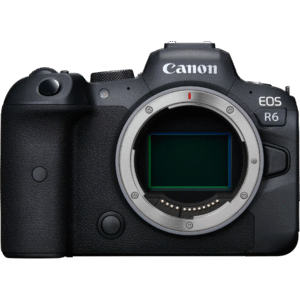
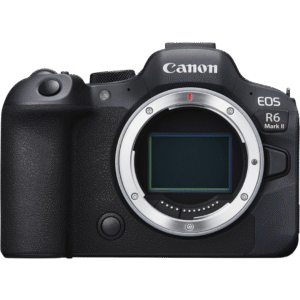
Here's what the Canon R6 vs R6 Mark II choice costs per day from our Jayanagar counter, with the add-ons wedding shooters book most.
| Wedding setup | What to book | Day cost |
|---|---|---|
| Stills-first, single shooter | Canon EOS R6 | ₹2,000 |
| Hybrid photo + video, single shooter | Canon EOS R6 Mark II | ₹2,500 |
| Two bodies, budget | 2 × Canon EOS R6 | ₹4,000 |
| Two bodies, main + backup | R6 Mark II + R6 | ₹4,500 |
| Two bodies, both hybrid | 2 × Canon EOS R6 Mark II | ₹5,000 |
Rates per 24 hours, before tax. Refundable deposit applies. Lenses, cards and spare batteries are extra on body-only hires. See the full camera rental price list.
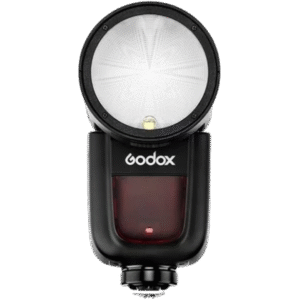
Because both cameras use the RF mount, you can rent lenses for either body from the same catalogue. Popular wedding choices include a 24-70mm f/2.8 for coverage, a 70-200mm f/2.8 for ceremony candids, and an 85mm prime for portraits. Our wedding camera rentals range covers bodies, and you can add wedding photography equipment rentals such as flashes and LED lights to the same booking.
Which one should you choose?
Ultimately, the Canon R6 vs R6 Mark II decision depends on your shooting style more than on the spec sheet.
Choose the Canon R6 if…
- You shoot mostly stills and keep video clips short
- You need a second or backup body that matches your main Canon kit
- Budget matters more than having the newest autofocus
- You already own LP-E6NH batteries and RF lenses and want the lowest-cost route into full frame
Consider the Canon R6 Mark II if…
- You deliver photo and video together, or film full ceremonies
- You shoot fast, crowded events like the baraat and sangeet and want stickier tracking
- You work long days and want fewer battery swaps
- You want the extra cropping room of 24.2MP for candid shots taken from a distance
For wedding photographers weighing the details
Use this table to match the Canon R6 vs R6 Mark II decision to what your bookings actually need.
| Your priority | Better fit | Why |
|---|---|---|
| Stills-only, tight budget | R6 | Same core image quality and low-light ability at a lower cost |
| Hybrid photo + video | R6 Mark II | No 30-minute limit and better heat management |
| Fast action and crowds | R6 Mark II | Updated tracking, 40 fps and pre-shooting |
| Very long wedding days | R6 Mark II | Approx. 50% more LCD battery life by Canon's figures |
| Very dark venues | Either | Matched ISO, AF floor and IBIS; invest in a fast lens first |
| Second or backup body | R6 | Shares batteries, grip and lenses with the Mark II |
| Short rental for one wedding | R6 Mark II | Lets you test the upgrade before you commit |
What about the Canon EOS R6 Mark III?
Canon announced the EOS R6 Mark III in November 2025 with a 32.5MP sensor and internal 7K RAW video. It sits in a higher price bracket, so for many wedding photographers the Canon R6 vs R6 Mark II comparison is still the more relevant one.
The Mark III also adds a CFexpress Type B slot alongside SD and up to 8.5 stops of stabilisation. It suits hybrid shooters who want more resolution and higher-end video. Meanwhile, for stills-first wedding work on a budget, the R6 and R6 Mark II remain strong value, particularly when rented.
Frequently asked questions
Is the Canon R6 good for wedding photography?
Yes. The Canon EOS R6 has a full-frame sensor, dual SD card slots, eye-detection autofocus and up to 8 stops of IBIS. However, its main limits for weddings are a 29:59 video clip cap and shorter battery life than the R6 Mark II.
Is the R6 Mark II worth it for wedding photography?
For hybrid shooters and photographers who cover long, fast-moving events, yes, provided the Canon R6 vs R6 Mark II price gap fits your budget. The R6 Mark II adds better tracking, more battery life, 24.2MP files and no 30-minute video limit. On the other hand, stills-only shooters on a budget may find the R6 enough.
Is the R6 Mark II better in low light?
Not by much. On low light, Canon R6 vs R6 Mark II is close to a tie on paper: both cameras share the same ISO range, -6.5 EV focus limit and IBIS rating. Instead, the Mark II's advantage in dark venues comes mostly from more reliable subject tracking.
Which is better for wedding photography, R6 or R6 Mark II?
In a Canon R6 vs R6 Mark II comparison for weddings, the Mark II is the better all-round camera. Even so, the R6 remains a sensible choice as a second body, a backup or a lower-cost stills camera.
Is the Canon R6 Mark II worth renting for a wedding?
Yes, especially if you plan to film long rituals, need a dependable main body for a busy weekend, or want to test the camera before buying it. At G.K. Vale it rents for ₹2,500 per day.
Can the R6 handle a full wedding day?
Yes, with preparation. Carry at least three charged LP-E6NH batteries, shoot stills with the mechanical shutter indoors, and keep video clips under 30 minutes.
Which Canon camera is better for wedding photography?
Among these two, the R6 Mark II suits most wedding photographers better. For example, newer bodies such as the R6 Mark III offer more resolution and video features at a higher cost, so the right choice depends on your budget and deliverables.
Key takeaway
The Canon R6 vs R6 Mark II choice comes down to how you shoot a wedding.
- Choose the R6 if you are a stills-first photographer, need a second or backup body, or want the lowest-cost Canon full-frame option.
- Choose the R6 Mark II if you shoot photo and video, cover fast and crowded events, or work long days where battery and heat limits matter.
- What matters most for weddings is reliable focus on moving people, enough battery for 12+ hours, dual-card backup and good low-light performance. Both bodies cover the last two equally; the Mark II pulls ahead on the first two.
- Renting makes sense when you want to test the Mark II before buying, need an extra body for peak season, or want a backup for a destination wedding.
Book the R6 or R6 Mark II for your next wedding
Still undecided on Canon R6 vs R6 Mark II? Shoot one wedding with each and let the files decide. Compare the Canon EOS R6 Mark II rental and Canon EOS R6 rental options, then add the lenses you need from our Canon lens rentals range. Then pick your dates, and the camera's ready before the mehendi is dry.
G.K. Vale Camera Rentals - photography experts since 1910
61/63, 8th B Main Rd, 27th Cross, 4th T Block East, 4th Block, Jayanagar, Bengaluru, Karnataka 560011
Phone: +91 99000 18134 · Hours: Mon–Sun, 10:00–19:30